- Home
- Useful articles
- How many years can you drive on these tires?
(067) 199 49 49

-
menu
Eng
(067) 199 49 49
menu
Eng
11/06/2026
450
 Buying used car tires can be a reasonable alternative to a new set if the driver does not take the first available option, but checks the tread, production date, sidewall condition, and evenness of wear. Used tires make sense when they still have a normal remaining service life, are not dried out, damaged, or bulged, and are sold as a set or pair with matching parameters.
The service life of a used tire depends not only on tread depth. Tire age, storage conditions, previous driving style, brand quality, tire pressure, suspension geometry, and seasonality all affect how long it will last. Two tires with the same 5 mm tread depth can be in different condition: one may be even and elastic, while the other may have microcracks, a damaged sidewall, or signs of overheating.
For passenger cars in most European countries, the minimum legal tread depth is 1.6 mm. This is a legal minimum, not a comfortable safety margin. For wet roads, it is better not to go below 3 mm, and for winter tires many service centers and automotive organizations recommend about 4 mm or more.
A new passenger car tire usually has around 7-8 mm of tread, but the exact figure depends on the tire type, brand, and model. That is why a used set should be evaluated not by the seller’s words, but by actual measurements at several points on each tire.
Below is a practical reference. It is not a guaranteed service life, but a normal working estimate for tires in good condition with no hidden defects, correct pressure, and no aggressive driving.
| Tread depth | Operating conditions | Approximate period | Behavior on wet roads | Noise |
| 7-8 mm | City or mixed driving | 18-24 months | Good | Low |
| 6-7 mm | Mixed driving | 12-18 months | Good or normal | Low / medium |
| 5-6 mm | City, highway without overloads | 9-15 months | Normal | Medium |
| 4-5 mm | Mainly city driving | 6-12 months | Acceptable, but with a smaller safety margin | Medium / increased |
| 3-4 mm | Short trips, careful driving | 3-8 months | Weaker in rain | Increased |
| 2-3 mm | Only as a temporary solution | 1-3 months | Poor, high aquaplaning risk | High |
| 1.6-2 mm | Emergency remaining life | Up to 1 month or immediate replacement | Critical | Very high |
The savings when buying used tires can indeed be noticeable. Most often, the difference between a new set and used tires is 40-70%, but it depends on the size, brand, season, remaining tread depth, and condition of the specific set.
The best value is not the cheapest tires with an unknown history, but inspected used tires from the mid-range or premium segment with a normal remaining tread depth. In this case, the driver gets better rubber quality, more predictable wet-road behavior, and often a lower cost per season of use.
| Tire segment | New tire, EUR | Used tire, EUR | Savings, EUR | Savings |
| Economy class 175/65R14 | 45-55 | 15-22 | 28-35 | 55-65% |
| Medium size 205/55R16 | 65-85 | 20-30 | 40-55 | 52-62% |
| Premium 225/45R17 | 120-160 | 35-50 | 75-110 | 55-70% |
| SUV / off-road 235/75R15 | 90-110 | 25-40 | 55-70 | 50-65% |
| Sport 255/40R18 | 140-200 | 40-70 | 100-130 | 58-72% |
For calm city driving, used tires with 5-6 mm tread depth can normally last 18-24 months. The load is lower, speeds are lower, and wear progresses more slowly. In this scenario, the savings on a set are often noticeable, especially if you buy an even pair or a set without sidewall repairs.
If the car is used both in the city and on the highway, it is better to look for used tires with at least 4-5 mm of tread. The real service life is usually 12-18 months. Here, you need to pay closer attention to balancing, pressure, and evenness of wear, because highway driving reveals tire problems faster.
For high annual mileage, it is advisable to choose used tires with 5-6 mm of tread depth or more. If the remaining tread is lower, the savings quickly disappear because the tires will need replacing sooner. With active use, a set may last 8-12 months, so before buying, you should calculate not only the purchase price but also the cost per season or per 10,000 km.
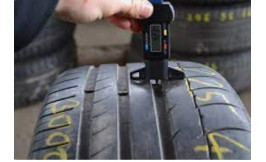
The best way to check is with a tread depth gauge. It is inexpensive, shows a specific number, and removes the need to argue with the seller by eye. Measurements should be taken in several places across the width of the tread and on each tire separately.
A coin is suitable only as a quick approximate test. In Europe, a 1 euro coin is often used: if the gold rim is clearly visible after inserting it into the tread groove, the remaining tread is already low. But when buying a set, it is better not to rely only on a coin.
| Checking method | Accuracy | Cost | Check time | Availability |
| 50 pence coin or equivalent | Approx. ±1 mm | Free | 2-3 min | Available anywhere |
| 1 euro coin | Approx. ±0.5-1 mm | Free | 2-3 min | Available in Europe |
| Mechanical tread depth gauge | Approx. ±0.1 mm | 5-15 EUR | 1-2 min | Auto parts stores |
| Digital tread depth gauge | Approx. ±0.05 mm | 15-40 EUR | 1 min | Auto parts stores |
| Inspection at a tire service | Approx. ±0.1 mm | 0-10 EUR | 10-15 min | Service centers and tire shops |
Tread depth is only the first filter. A tire with good tread may still be unsafe if it is old, overheated, has suffered a strong impact, was repaired incorrectly, or was stored in the sun for a long time.
The production date is shown on the sidewall as four digits. For example, 1524 means the 15th week of 2024. Tires older than 7-8 years should be checked especially carefully, even if the tread is still deep. After 10 years from the production date, it is better not to use the tire as a main set.
You should not buy tires with bulges, sidewall cuts, deep cracks, signs of a strong impact, bead deformation, or suspicious repairs. Such defects may appear not immediately, but at speed or under load.
Uneven wear often indicates problems with wheel alignment, pressure, or the suspension of the previous vehicle. If one area of the tread is worn 2 mm more than another, it is better not to buy that tire. It may be noisy, difficult to balance, and worse at holding the road.
To understand the real benefit, you need to calculate not only the purchase price but also the expected service life. Below is a simplified example for a set of four tires.
| Parameter | Used tires | New tires | Difference |
| Set price | 60-90 EUR | 200-280 EUR | 110-190 EUR at the start |
| Period of use | 12-18 months | 36-48 months | New tires last longer |
| Cost per year | 40-75 EUR | 50-90 EUR | Used tires may be cheaper |
| Cost per month | 3.5-6.3 EUR | 4.2-7.5 EUR | Small difference |
| Cost per 10,000 km | 4-8 EUR | 5-10 EUR | Depends on mileage |
In the first year, used tires win on price. But if the rubber is old, uneven, or has little tread left, the savings disappear because of quick replacement, repair, or discomfort while driving.
To avoid driving tires down to an emergency condition, it is better to have a simple inspection schedule. It takes only a few minutes but helps detect cracks, pressure loss, or uneven wear in time.
| Period | Recommended action | Approximate cost | Priority |
| When buying | Measure tread depth, check DOT, inspect sidewall | Included in purchase | Critical |
| Monthly | Check pressure and visually inspect tires | Free | High |
| Every 3 months | Measure tread depth | 0-5 EUR | High |
| Every 6 months | Rotation and balancing if needed | 20-40 EUR | Medium |
| Every 12 months | Detailed inspection at a service center | 10-20 EUR | Medium |
| At 4 mm tread depth | Plan replacement, especially before the rainy season or winter | Start looking | High |
| At 2-2.5 mm tread depth | Urgent replacement | Full replacement | Critical |
Summer tires have a harder compound, so with correct pressure and no overheating, they wear predictably. Used summer tires with 4-5 mm tread depth can last 8-14 months if the car is driven mainly in the city or in a calm mixed mode.
Winter rubber is softer, works better in cold weather, but wears faster at above-zero temperatures. If used only in winter, a set with 5-6 mm tread depth can last 12-20 months. If winter tires are used all year round, their service life drops sharply, and the car’s behavior in summer becomes worse.
All-season tires are a compromise for moderate climates and calm driving. With year-round use, a used set with 4-5 mm tread can last 10-16 months. For harsh winters, mountain roads, or frequent highway trips, it is better to have separate seasonal sets.
Tire pressure should be checked at least once a month and before a long trip. Low pressure overheats the tire and wears the shoulder areas, while excessive pressure wears the center of the tread faster. Recommended values are listed on the driver’s door pillar, fuel filler flap, or in the vehicle manual.
Rotating tires every 5,000-10,000 km helps even out wear. On front-wheel-drive cars, the front wheels usually wear faster due to steering, braking, and drive force. Rotation is especially useful for a used set where the tread reserve is already not very large.
If there is vibration at speed, the car pulls to one side, or the tread wears in patches, you need to check balancing and wheel geometry. After a strong hit into a pothole, it is better to check alignment immediately, because one trip with incorrect geometry can quickly ruin a good tire.
Sharp starts, braking, fast cornering, and driving on broken roads quickly consume the remaining service life. Smooth driving can add several months of use to a set, while aggressive driving can take away a season even from tires with normal tread.
A common question is what is better: used premium-brand tires or new budget tires? There is no single answer. If premium used tires are fresh, even, undamaged, and have 5-6 mm of tread, they will often be more pleasant to drive, quieter, and more stable. But if the premium tire is old, dried out, or repaired, a new budget tire will be the more sensible choice.
| Criterion | Used premium | New budget | Used budget |
| Set price | 50-80 EUR | 100-140 EUR | 30-50 EUR |
| Time until 3 mm | 10-16 months | 20-28 months | 6-10 months |
| Wet-road braking | Good if the rubber is fresh | Satisfactory / normal | Weak or unstable |
| Noise and comfort | Often good | Average or normal | Average |
| Reliability | High if condition is correct | Medium | Uncertain |
| Cost per km | 0.4-0.8 EUR | 0.5-0.9 EUR | 0.3-0.6 EUR |
| Recommendation | Best option if properly checked | Safer choice for longer use | Only as a budget temporary solution |
The European used tire market is large because many sets are removed from leased cars, corporate fleets, or seasonal replacement cycles. Tires with different remaining tread depths enter the market: from almost new to those that should not be fitted to a car.
Exact country shares should not be presented as official statistics without a specific source. For an SEO article, it is more correct to speak about an approximate market snapshot: Germany, France, Poland, the United Kingdom, and Spain have stable demand for inspected used tires, especially in popular sizes such as 195/65R15, 205/55R16, 225/45R17, and SUV sizes.
| Country | Demand for used tires | Approximate price, EUR | Popular brands | Typical inspection approach |
| France | High | 20-40 | Michelin, Goodyear, Pirelli | Condition inspection, tread, DOT |
| Germany | High | 18-35 | Continental, Dunlop, Bridgestone | Strong focus on technical condition |
| United Kingdom | High | 16-32 | Dunlop, Goodyear, Bridgestone | Tread and defect inspection |
| Poland | Stable | 14-28 | Michelin, Nokian, Continental | Price, remaining tread, seasonality |
| Spain | Stable | 15-30 | Goodyear, Pirelli, Bridgestone | Rubber condition after heat and storage |
Affordability
The main reason is the lower price. For a driver who needs to quickly replace a set before the season or sell a car with decent tires, used tires can be a practical solution without overpaying for a new set.
Quality of proven brands
Used Michelin, Continental, Bridgestone, Goodyear, Nokian, or Pirelli tires often remain better than cheap new tires of unknown origin. But the brand does not cancel inspection: an old or damaged premium tire does not become safe just because of the logo.
Environmental aspect
Reusing suitable tires reduces waste and extends the life of a product that has not yet exhausted its resource. This only makes sense for safe tires. Tires with bulges, deep cracks, or critically low tread should not be resold, but recycled.
Wide selection
The market offers rare sizes, pairs for one axle, seasonal sets, and premium models that are expensive when new. For convenient selection, it is worth checking specialized stores, for example used tires from Eurokoleso, where you can compare size, season, brand, and remaining tread depth at once.
Unknown service history
The buyer does not always know how the tire was used before. It may have been driven with incorrect pressure, suffered a strong impact, overheated, or been mounted on a car with suspension problems. That is why inspection and measurement are mandatory.
Shorter warranty
Used tires usually have a shorter warranty than new ones. Often the seller gives a few days or months for obvious defects, but does not cover natural wear. This should be considered in the budget.
Hidden damage
Some defects become visible only after installation, balancing, or the first trips. If the tire vibrates, does not balance well, loses air quickly, or has an uneven sidewall, it is better to return it to the seller instead of trying to “drive it out.”
You can drive on used tires from several months to two seasons or more, but only if the tires have normal tread, a fresh DOT, even wear, and no dangerous defects. The main reference point when buying is not the price, but the ratio of remaining life, age, and condition.
For a safe purchase, it is better to look for tires with 4-5 mm of tread or more, avoid tires older than 7-8 years for active driving, and avoid bulges and uneven wear. The minimum 1.6 mm is no longer a reserve; it is the limit after which the tire must be replaced.