- Home
- Useful articles
- How much to inflate electric car tires in winter
(067) 199 49 49

-
menu
Eng
(067) 199 49 49
menu
Eng
20/08/2025
3736
 Correct tire pressure directly affects the behavior of the car on the road. This is especially noticeable for electric cars, as they are heavier than gasoline or diesel counterparts and have an instant torque response. If the tire pressure is incorrect, the range is reduced, the tires wear out faster, and handling becomes more difficult. In winter, this topic is even more relevant due to temperature changes and slippery surfaces.
The battery increases the mass of an electric car by an average of 200–300 kilograms. This means that the load on each wheel increases. The tires must withstand greater pressure and at the same time maintain elasticity in frost. For example, the Tesla Model 3 weighs over 1,700 kg, and with four wheels, the load on each of them exceeds 400 kg. For the Model X, the mass reaches over 2.4 tons, and the tire pressure must be correspondingly higher.
Manufacturers indicate the pressure in the door opening or in the car manual. For most passenger electric cars in the winter, the norm is 2.4–2.6 bar. In the Tesla Model 3, it is usually recommended to pump 2.6 bar under standard conditions. For crossovers such as the Model Y or Model X, the norm is 2.7–2.9 bar. If you put winter tires with a smaller or larger profile, the numbers may differ slightly, but the general trend is the same - in winter the pressure should be closer to the upper limit of the recommended range.
| Electric vehicle model | Wheel size | Recommended pressure (winter) |
|---|---|---|
| Tesla Model 3 | R18 / R19 | ≈ 2.6 bar |
| Tesla Model S | R19 / R21 | ≈ 2.7 bar |
| Tesla Model Y | R19 / R20 | ≈ 2.8 bar |
| Tesla Model X | R20 / R22 | ≈ 2.9 bar |
| Nissan Leaf | R16 / R17 | ≈ 2.4–2.5 bar |
| Volkswagen ID.4 | R19 / R20 | ≈ 2.6–2.7 bar |
| Hyundai Ioniq 5 | R19 / R20 | ≈ 2.6–2.8 bar |
| BMW i3 | R19 | ≈ 2.5–2.7 bar |
In cold air, the pressure in the wheels decreases. The average drop is approximately 0.07–0.1 bar for every ten degrees. That is, if in the fall you pumped up the wheels to 2.6 bar at +20 °C, then at -10 °C the pressure will drop to approximately 2.3 bar. This is already below the norm, and the driving range will be less. Therefore, in the winter season, the pressure is checked more often and the tires are pumped up, focusing not on summer indicators, but on those relevant for frosts.
The pressure should be measured only when the tire is cold. If the car has just been driven, the rubber compound heats up, and the reading on the pressure gauge will be inflated. You will get the most accurate results after overnight parking or three hours after stopping. In winter, it is better to have your own electronic pressure gauge and check your tires at least once every two weeks.
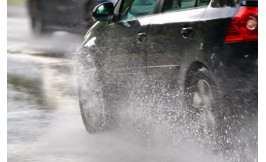
Some drivers deliberately lower the pressure, thinking that this way the tire will “cling” to the road better. In practice, this leads to the opposite effect. The contact area becomes wider, but the tread pushes through a layer of snow or water more strongly, and the risk of aquaplaning increases. In addition, when driving at low pressure, rolling resistance increases, the electric motor consumes more energy, and the battery discharges faster. For an electric car, this means a loss of 5–10 percent of the range.
Over-inflated pressure is also undesirable. The wheel loses part of the contact area, the car holds on to the icy road worse, and the tread wears out faster in the center. In addition, the stiffness increases and comfort on bumps decreases. In the case of an electric car, this also adds extraneous sounds to the cabin, where there is no engine noise.
To avoid unnecessary energy consumption and extend the life of the tires, it is worth keeping the pressure within the limits recommended by the manufacturer, but in winter it is better to approach the upper limit. This will help compensate for the drop in performance at low temperatures. For Tesla Model 3, 2.6 bar will be optimal, for Model S - about 2.7 bar, for Model Y - 2.8 bar, and for Model X - up to 2.9 bar.
At Eurokoleso, you can choose used winter tires https://eurokoleso.com.ua/ua/ that meet the load of electric cars and have a certificateification for use on Tesla, Nissan Leaf, VW ID and other models. All kits are tested for tightness and even wear. In addition to sales, the company offers professional tire fitting and advice on the correct pressure for your model.
Properly inflated tires in winter mean energy savings, even wear and predictable behavior of the car on slippery roads. By contacting Eurowheel, you will receive not only high-quality rubber, but also operating tips that will help your electric vehicle confidently overcome winter routes.