- Home
- Useful articles
- Hernia on the tire
(067) 199 49 49

-
menu
Eng
(067) 199 49 49
menu
Eng
26/08/2026
220
A tire bulge appears as a rounded or elongated protrusion on the sidewall, shoulder area, or inner side of the wheel. The bulge forms after damage to the cord threads that make up the tire carcass and maintain its shape under internal pressure. Air presses against the weakened area from the inside, the outer rubber layer stretches, and a noticeable bump appears on the surface.
The outer rubber performs a protective function, while the main load is carried by textile or metal cords inside the carcass. Breakage of some cords reduces the strength of a specific area, so the sidewall loses its even shape even at normal pressure. Even a small bulge confirms structural damage because an intact sidewall distributes internal pressure evenly across its entire surface.
A tire bulge is often noticed after hitting a pothole, striking a curb, or during seasonal tire service. The bulge can also become visible several days after an impact as the damaged area gradually stretches under the vehicle's weight, pressure, and temperature. The absence of a puncture and stable tire pressure do not confirm that the tire is sound, because a bulge results from carcass damage rather than a through-hole in the rubber.
A true tire bulge protrudes above the sidewall surface and changes shape when the wheel is loaded. A rounded bulge usually occupies a small local area, while an elongated deformation may extend along the shoulder area or near the bead. The bulge often becomes larger after inflating the tire, heating it during driving, or loading the vehicle.
Some tires have visible vertical indentations that form where carcass layers are joined. Such an indentation is directed inward, has an even elongated shape, and does not grow under pressure. A structural splice does not create a rounded outward bulge, so careful inspection makes it easy to distinguish from damage.
A raised area near lettering, a decorative element, or a thicker section of rubber also requires checking the shape of the entire sidewall. Factory features repeat symmetrically and have the same thickness in adjacent areas, while a bulge disrupts the tire's even contour in only one location. Rotating the raised wheel helps reveal a change in profile and compare the suspicious area with the rest of the sidewall.
An inner-sidewall bulge remains hidden during a routine inspection of a parked vehicle. Checking the inner side requires turning the steering wheel, lifting the vehicle, or removing the wheel. Jolts while driving, vibration, periodic contact between the tire and wheel-arch liner, and a change in tread shape are reasons to inspect both sidewalls.
The most common cause of a tire bulge is severe compression of the sidewall between the rim edge and a road obstacle. This occurs when the wheel hits a pothole with a sharp edge, crosses a high asphalt joint, or strikes a curb. The rubber often remains externally intact after the impact, while the cords inside are stretched, partially torn, or completely broken.
Vehicle speed determines the impact energy and the load on the carcass. At high speed, the wheel cannot smoothly follow the edge of a pothole, so the sidewall receives a short, concentrated impact. A heavy vehicle, passengers, and cargo in the trunk further increase the compression force.
Insufficient pressure increases sidewall deflection and reduces the distance between the road and the rim edge. A soft tire folds more severely during an impact, allowing the rim to pinch the rubber and damage the internal cords. Prolonged driving with low pressure also overheats the sidewall because the rubber continuously flexes with every wheel revolution.
Excessive pressure creates a different damage mechanism. An overinflated tire is stiffer and absorbs sharp road irregularities less effectively, so a significant portion of the impact is transferred directly to the carcass. Correct pressure provides the designed amount of sidewall deflection and allows the tire to absorb part of the road load.
Low-profile tires have a short sidewall, leaving less rubber between the rim and the road to absorb an impact. A large wheel diameter, stiff suspension, and high vehicle mass further increase the load on a low-profile tire. Even a relatively small pothole can damage such a tire when crossed at speed.
Contact with a curb creates a localized load directly on the side of the tire. During parking, the wheel is often pressed against a sharp edge at an angle, causing the cord to stretch in a small area. A scuff or scratch shows the contact point, but the internal break may be located next to the visible mark.
Vehicle overloading increases the constant deflection of all tires and raises the load on the carcass when driving over uneven surfaces. The wheel located closest to a heavy load receives the greatest stress. The tire load index must correspond to the vehicle weight and the actual load on each axle.
Rubber aging gradually reduces sidewall elasticity and the strength of the bond between internal layers. Cracks, hardening, and prolonged storage in unfavorable conditions increase the risk of cord failure after an ordinary impact. A large remaining tread depth does not compensate for carcass aging, so tire age should be assessed together with its external condition.
An error during tire fitting can also damage the bead area or lower part of the sidewall. Incorrect positioning of the mounting head, excessive force from a tire lever, and installation without enough mounting lubricant can tear the rubber and cords. A bulge that appears after installation requires tire removal and inspection of the inner surface.
A manufacturing defect is less common than impact damage, but it can also cause local delamination or weakening of the carcass. Such a bulge often appears on a new tire without scuffs, cuts, or signs of a strong impact. A conclusion that the damage is manufacturing-related is made after inspecting the removed tire and analyzing the condition of its internal layers.
The damaged area has different stiffness from the rest of the sidewall. During each revolution, the bulge is compressed at the bottom of the wheel and stretches again under internal pressure after leaving the contact patch. Repeated deformation heats the rubber and gradually increases the area of internal damage.
A bulge in the shoulder area changes the wheel's outer radius and creates rhythmic jolts while driving. Depending on which wheel is damaged, the driver may feel bouncing at low speed, steering-wheel vibration, or vibration through the seat. Balancing weights do not eliminate this defect because the problem is related to the shape and stiffness of the carcass.
A bulge confined to the sidewall may not produce noticeable vibration, but the absence of vibration does not reduce the risk of rupture. The sidewall constantly flexes, so the damaged area is loaded even during steady travel on a straight road. Cornering, braking, and hitting a pothole increase the deformation further.
Higher speed increases the flexing frequency and tire temperature. Heated air raises internal pressure, while softened rubber stretches more around the damaged carcass. A long highway trip places more stress on a bulge than moving the vehicle a short distance at low speed.
A sudden front-tire rupture changes steering effort and pulls the vehicle toward the damaged wheel. A rear-tire rupture reduces rear-axle stability and creates a risk of skidding. The most difficult situation occurs while cornering, overtaking, braking, or driving on a wet road.
Fragments of a damaged tire after a rupture can damage the wheel-arch liner, bumper, brake hose, ABS sensor wiring, or suspension components. Sudden pressure loss also leaves the rim unprotected, so it may deform after contacting the road surface. The consequences of tire failure often cost more than timely tire replacement.
A confirmed bulge means the load-bearing carcass is broken or weakened, so the tire no longer retains its original factory strength. The size of the bulge shows only the external deformation and does not indicate how many internal cords are damaged. A small bulge can rupture after the next impact just as suddenly as a large one.
The location of the bulge does not create a safe operating scenario. A bulge on the outer sidewall, inner sidewall, shoulder area, or near the bead confirms carcass damage in every case. The damaged area continues to deform under pressure regardless of whether it touches the road.
Moving the wheel from the front axle to the rear only changes the nature of the possible consequences. The front axle transfers runout to the steering wheel, while the rear axle affects the vehicle's directional stability during cornering and braking. A damaged tire remains a source of sudden pressure loss on any axle.
Reducing pressure makes the bulge look smaller but simultaneously increases sidewall deflection and heat buildup while driving. Increasing pressure raises the load on the weakened area from the inside. Changing the pressure does not restore broken cords and does not create a safe mode for prolonged operation.
Further movement is acceptable only to clear the roadway or to travel a very short distance to a safe location when no spare wheel is available. In that situation, speed should be reduced to the minimum, unnecessary cargo should be removed, and a route without potholes or sharp turns should be chosen. A large bulge, crack, exposed cords, pressure loss, or severe runout rules out driving the vehicle under its own power.
A spare wheel, mobile tire service, or tow truck eliminates the need to load the damaged tire. A sealant-and-compressor kit is intended for certain tread punctures and does not restore the carcass after a bulge has formed.
A conventional patch closes a puncture and restores the airtightness of the inner liner. A bulge can occur without a puncture because the air remains inside the tire and stretches the weakened carcass area. Patching the inner surface does not reconnect broken cords or restore the sidewall's original strength.
A reinforced patch reduces local rubber stretching but creates a rigid area on a sidewall that continuously flexes while driving. The boundary between the rigid repair and the flexible carcass becomes an additional stress concentration point. Such a repair does not restore the tire's speed rating, permitted load, or predictable service life.
Hot vulcanization can fill damaged rubber and level the outer surface. The vulcanized material changes the appearance of the bulge but does not restore continuity of the internal cords. After such an intervention, the tire has different stiffness, mass, and thermal behavior in the repaired area.
A technician may offer repair as a temporary solution for low-speed equipment or for movement away from public roads. A passenger car operates at higher speeds and encounters potholes, turns, and emergency braking, so a repaired sidewall does not provide predictable strength. Replacing the damaged tire remains the proper way to eliminate a bulge.
The new tire must match the factory size, construction type, load index, and speed rating. It is preferable to install the same model with the same tread pattern because different tires have different stiffness, grip, and water-displacement behavior.
The condition of the other tire on the same axle determines how many tires should be replaced. A small difference in remaining tread depth allows one new tire to be installed if the model and specifications are the same. Significant wear on the other tire creates a difference in outer diameter and grip, so a new pair should be installed on the axle.
For all-wheel-drive vehicles, differences in wheel diameter have particular importance. A constant difference in rotational speed loads the center coupling, differentials, and other drivetrain components. The permissible difference in remaining tread depth should be checked against the vehicle manufacturer's recommendations.
After a severe impact, a technician checks the wheel rim for radial and lateral runout. A deformed rim can damage the new tire, create vibration, or compromise bead sealing. Suspension inspection is required if there is knocking, vehicle pull, an off-center steering wheel, or an uneven wheel position in the wheel arch.
The new tire is installed after checking the valve, cleaning the rim bead seats, and precisely balancing the complete wheel. A final inspection after installation confirms even bead seating and the absence of damage on adjacent tires.
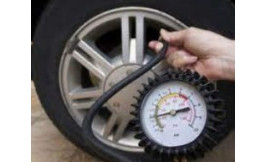
Regular pressure checks maintain the correct sidewall shape and reduce the risk of the tire being pinched between the rim and the road. Pressure should be measured on cold tires with a reliable pressure gauge and compared with the vehicle manufacturer's placard. For a fully loaded vehicle, use the separate recommended values if the manufacturer provides them.
Reduce speed in advance before potholes, road joints, and damaged sections of pavement. Heavy braking at the exact moment of impact loads the front axle and presses the tire more firmly against the pothole edge. Smoothly reducing speed before the obstacle lowers the load on both the carcass and the rim.
Curbs should be crossed slowly and at as close to a right angle as possible. Sliding the sidewall along a sharp edge causes scuffs, cuts, and localized cord stretching. Parking with the tire constantly pressed against a curb also deforms the sidewall.
The vehicle load must comply with the permissible gross vehicle weight and the tires' load indices. Heavy items in the trunk should be distributed evenly so that one wheel does not carry an excessive share of the weight. Tire pressure before a trip with passengers and luggage should be adjusted according to the recommendations for a loaded vehicle.
Tire size and rim width must comply with the permitted parameters. Excessive stretching of a tire on a wide rim changes the sidewall position, while a rim that is too narrow distorts the tire profile and increases deformation of the shoulder area. Low-profile tires require particularly careful monitoring of pressure and speed on uneven roads.
Seasonal storage also affects the condition of the carcass. Tires without rims should be stored vertically and rotated periodically, while complete wheels should be stacked horizontally or suspended by the rims. The storage area should be dry, cool, and protected from sunlight, heaters, and chemicals.
After a strong impact, both sidewalls should be inspected even if the pressure remains stable. A second inspection after several days can reveal a bulge that has developed gradually. The inner side should be checked on a lift or during the next visit to a tire service shop.
Stop the vehicle on a level, safe surface and inspect the size, location, and condition of the bulge. A crack, exposed cords, rapid pressure loss, or deformation in the shoulder area indicates an immediate risk of rupture.
The damaged wheel should be replaced with the spare. A temporary spare must be used within the speed and distance limits stated on its sidewall or in the vehicle owner's manual. If there is no spare wheel, call a mobile tire service or tow truck.
The damaged tire should be removed from the rim for inspection of the inner surface. Removal reveals delamination, pinch marks, torn cords, and bead condition, and also helps distinguish impact damage from a possible manufacturing defect.
After an impact, the rim should be checked on a balancing or runout machine because even slight distortion can cause runout with the new tire. The adjacent wheel on the same side should also be inspected because both tires often pass through the same pothole.
recommended articles